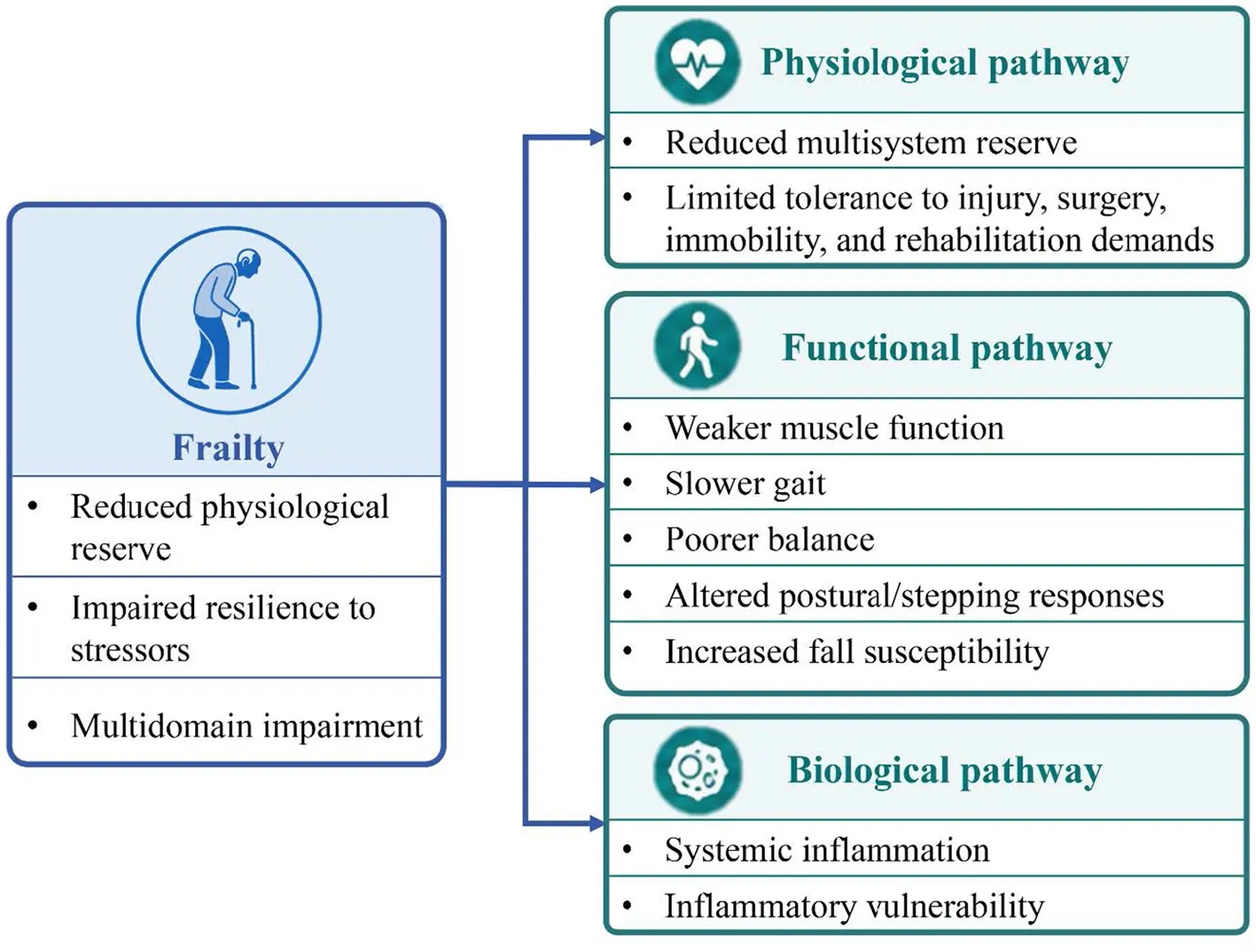
Fragility fractures are a major challenge in aging societies, causing pain, disability, loss of independence, recurrent fractures, and mortality. Although prevention appropriately emphasizes osteoporosis, bone mineral density (BMD), fracture-risk estimation, and treatment, fracture vulnerability is not determined by bone strength alone. Frailty, sarcopenia, impaired balance, falls, malnutrition, cognitive impairment, physiological reserve, and rehabilitation capacity also influence fracture occurrence and recovery. Thus, fragility fracture vulnerability should be considered a multidimensional risk state.
Frailty captures reductions in physiological reserve across mobility, nutrition, cognition, endurance, balance, and resilience. It is associated with falls, fractures, postoperative complications, functional decline, readmission, and mortality after hip fracture. Sarcopenia focuses on muscle strength, quantity or quality, and physical performance. Muscle dysfunction may impair gait stability, balance, protective responses, and impact attenuation during falls, while reduced muscle loading may negatively affect bone health. Sarcopenia can also limit mobility and rehabilitation after fracture. Handgrip strength, chair-stand performance, gait speed, balance testing, and muscle-mass assessment are among the measures used in evaluation.
Osteosarcopenia, the coexistence of osteoporosis or osteopenia and sarcopenia, bridges the skeletal and muscle aspects of fracture risk. However, it does not fully capture broader differences in physiological reserve, resilience, fall vulnerability, and recovery capacity. The proposed bone–muscle–function framework integrates three domains: bone, representing skeletal strength and structural fragility; muscle, representing neuromuscular capacity and physical performance; and function, representing patient-level reserve, mobility, fall vulnerability, rehabilitation participation, and recovery potential. The framework complements rather than replaces osteoporosis-centered care and organizes these domains for risk identification, vulnerability profiling, intervention planning, recovery planning, and secondary prevention.
Clinically, the framework supports multidimensional assessment before and after fracture. Before fracture, evaluation can combine fracture history, BMD or FRAX, muscle strength or performance, fall history, mobility limitations, and frailty screening to identify vulnerabilities. Interventions can then be individualized through osteoporosis treatment, resistance exercise, nutritional support, balance training, fall prevention, mobility support, geriatric assessment, and rehabilitation. After fracture, the framework integrates skeletal treatment with muscle and functional assessment to guide recovery and secondary prevention. Fracture liaison services may provide a practical platform for multidimensional post-fracture assessment, coordinated secondary prevention, and referral to rehabilitation or geriatric services. Future prospective cohort and intervention studies should validate the framework and determine whether vulnerability-based strategies improve skeletal and patient-centered outcomes.
Read the article here.
© 2026 Global Fragility Fracture Network | All Rights Reserved I Designed by Aaron Knight