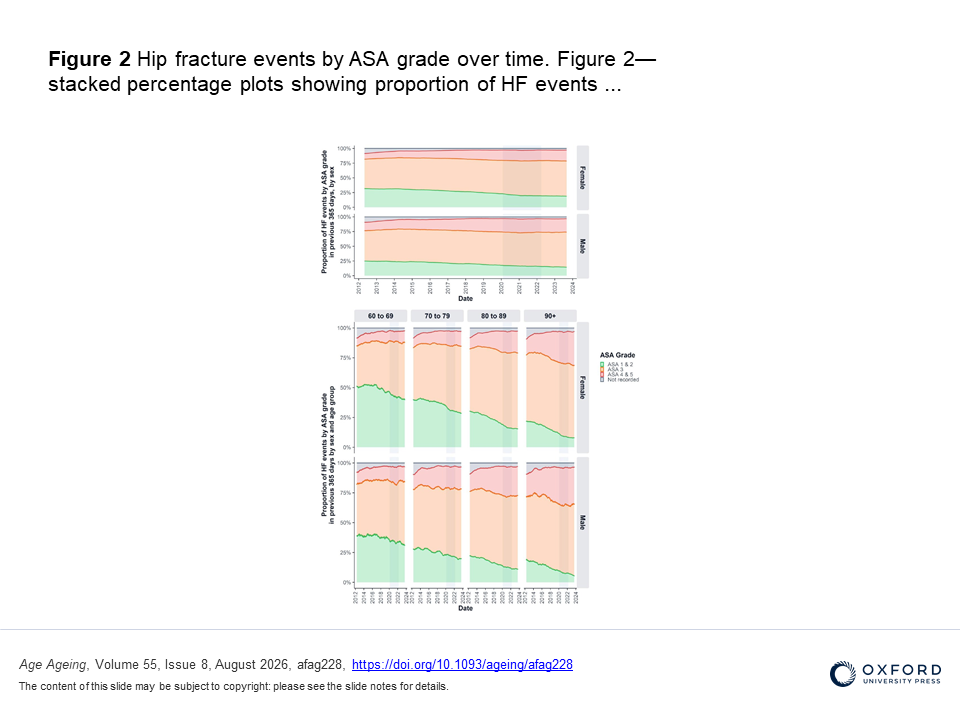
Hip fracture remains a major cause of morbidity and mortality among older adults and places a substantial burden on health and social care. Using data from the National Hip Fracture Database (NHFD), a recent study examined 735,436 hip fractures in people between 2011 2023; 71% were women, the mean age was 82.9 years.
The study concludes that although overall hip fracture incidence has fallen, annual numbers continue to rise and patients are increasingly comorbid. The authors call for prevention strategies that include older men, sufficient capacity for increasingly complex perioperative care, and appropriate resources for orthogeriatric multidisciplinary care, discharge planning and community-based intermediate care.
Accompanying editorial
In the accompanying editorial, Prof Antony Johansen describes hip fracture as a useful model for examining wider changes in the care of older people. He notes that modern surgery and anaesthesia are now consistently good and emphasises the importance of multidisciplinary management of frailty. He describes hip fracture and its operative management as a standardised “stress test” of frailty and highlights comprehensive geriatric assessment and orthogeriatrician-led multidisciplinary care as central elements of current hip fracture management.
The editorial also highlights the increasing proportion of men sustaining hip fractures and notes that men are nearly twice as likely to die after a hip fracture, despite NHFD data suggesting that they are more independent, more mobile, better nourished and have better cognition than women. Prof Johansen stresses the need for more detailed assessment to understand these differences. He also discusses the increasing comorbidity of patients while more continue to live in their own homes, and considers the role of shared decision-making and appropriate palliative or non-operative approaches in selected patients. Finally, he cautions that population-level prediction tools may not reliably predict outcomes for an individual patient and should not lead automatically to more conservative treatment decisions.
Read the article here.
Read the editorial here.
© 2026 Global Fragility Fracture Network | All Rights Reserved I Designed by Aaron Knight