
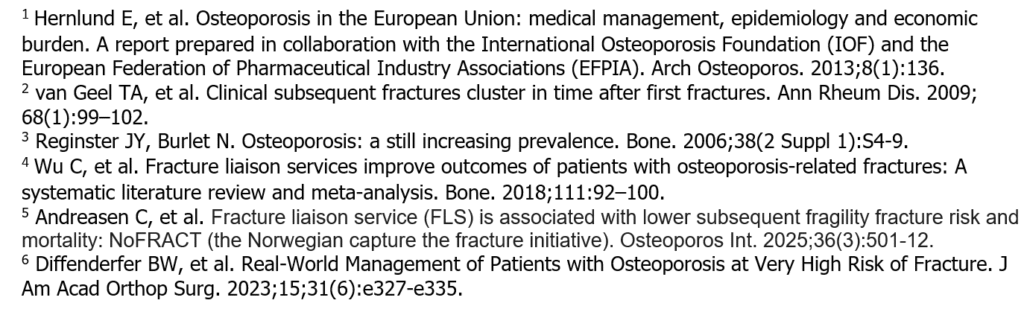
Despite progress in post-fracture care, many patients at very high fracture risk (VHFR) still receive no follow-up after an initial fragility fracture.[1] This remains the case even though having one fragility fracture significantly raises the risk of a subsequent fracture by up to five times in the following year, according to a population-based study of over 4,000 postmenopausal women.[2] With the cost of fragility fractures expected to reach a staggering 77 billion EUR in the European Union by 2050, the demand for effective and sustainable care pathways is rising rapidly.[3]
Fracture Liaison Services (FLSs) play a pivotal role in addressing this escalating burden on both patients and healthcare systems.[4] Real-world evidence shows that effective FLS implementation reduces future fracture risk, improves patient outcomes, and lowers health system burden—cutting hospital stays, surgeries, and the need for institutional care.[5] However, despite their proven benefits and the existence of national guidelines, fewer than 1 in 5 patients at very high fracture risk (1-6%) receive treatment in line with these recommendations.[6] This persistent gap in care highlights the urgent need for practical, evidence-based tools that can support healthcare professionals.
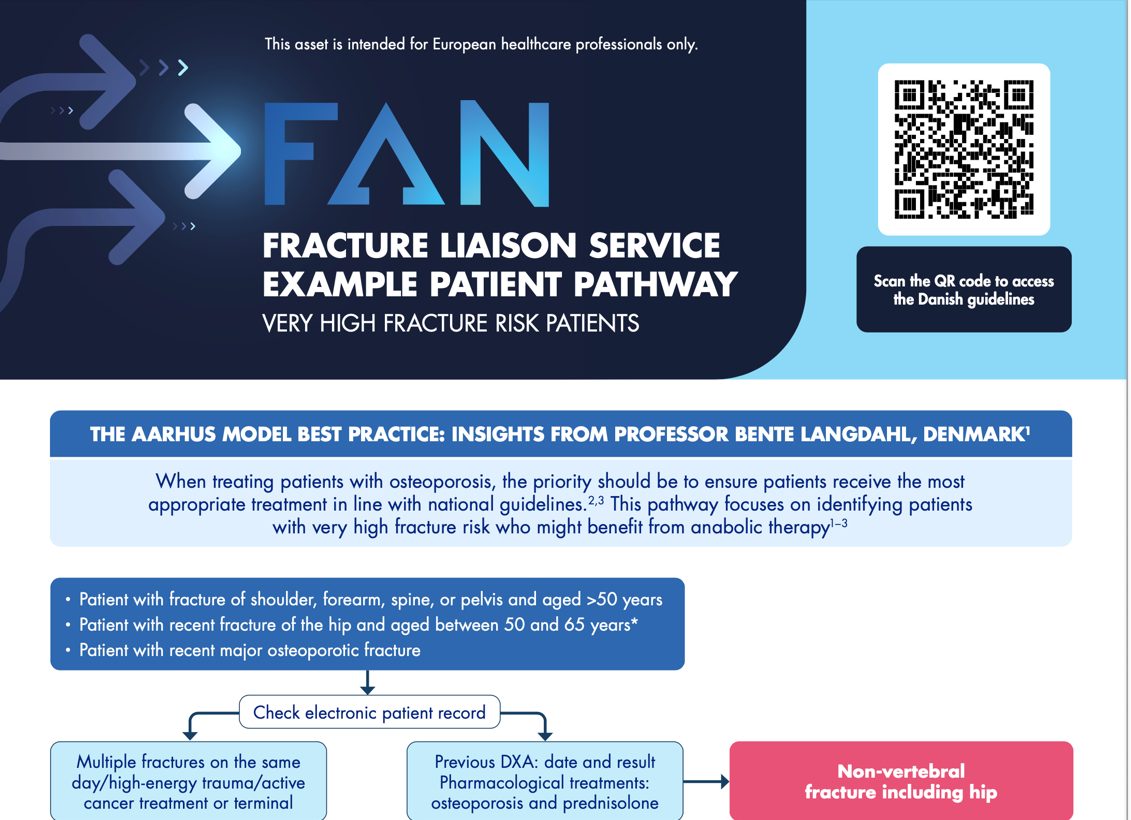
The Aarhus model is a best-in-class practical patient pathway designed to help healthcare professionals within FLSs identify patients at VHFR effectively, support clinical decision-making and optimize outcomes. Based on the work of Professor Bente Langdahl and her team in Aarhus, Denmark, the model offers step-by-step support for clinicians, grounded in real-world FLS practice and the latest guidance from the Danish Endocrine Society.
Specifically, the model provides a decision-making framework to support care of:
The model also underscores the importance of vertebral fracture assessment (VFA) and dual-energy x-ray absorptiometry (DXA) in establishing a clear risk profile for patients presenting with a fracture. Proactive use of VFA can uncover previously undiagnosed vertebral fractures, supporting patients in accessing timely and targeted treatment.
The Aarhus model is the latest addition to the FAN platform, an educational initiative founded by UCB and Amgen, with guidance from a Steering Committee of international experts. Since 2020, FAN has grown into a Europe-wide community of more than 400 FLS professionals, offering stepwise implementation workbooks, virtual learning, field-based support and peer-to-peer mentoring.
By adopting structured pathways like the Aarhus model, FLS teams can play a decisive role in preventing future fractures and safeguarding long-term health for patients at the highest risk.
*Patients with a hip fracture aged ≥65 years should be assessed by geriatricians
This post is provided by UCB.

© 2026 Global Fragility Fracture Network | All Rights Reserved I Designed by Aaron Knight