
Hip fractures are a growing global health concern due to aging populations and are commonly treated with surgery followed by rehabilitation and pain management. Opioids are widely used for short-term postoperative pain, but a significant proportion of patients continue using them long after recovery, increasing the risk of falls, complications, and mortality. Despite this, there is a lack of simple tools to identify which opioid-naïve patients are most at risk of long-term opioid therapy (LTOT) after hip fracture surgery. This study aimed to address this gap by developing a practical prediction model that can be applied at hospital discharge to support targeted care.
In a cohort of 26,057 patients aged ≥65 years, 8,095 (31.1%) developed LTOT within one year of surgery, confirming that prolonged opioid use is common. The final model included 8 easily available factors: age, marital status, fracture type, mobility at discharge, preoperative non-opioid pain medication, use of blood thinners, surgical delay, and length of hospital stay. Patients with poorer postoperative mobility, prior pain medication use, and weaker social support (e.g., higher rates of divorced or never-married status) were more likely to develop LTOT.
At a practical risk threshold (~30%), the model identified about 72% of patients who developed LTOT and correctly ruled out about 54% who did not. It performed better at identifying low-risk patients, with 75%–86% of those classified as low risk not progressing to long-term opioid use.
Overall, the findings show that LTOT after hip fracture is frequent but partly predictable using a small set of routine clinical and social factors. This model provides a straightforward way to identify higher-risk patients at discharge and could support more targeted pain management and follow-up care, although further validation is needed before widespread clinical use.
Read the article here.
Join the FFN webinar on “Current Management of Fragility Upper Limb Fractures” on 28 May 2026 at 18:00 CET. This expert-led session will explore key aspects of upper limb fragility fractures, from epidemiology and non-operative care to surgical decision-making and orthogeriatric management.
Featuring an international panel of specialists, the program includes focused talks, practical insights, and interactive discussions, providing a comprehensive update for clinicians involved in fragility fracture care.
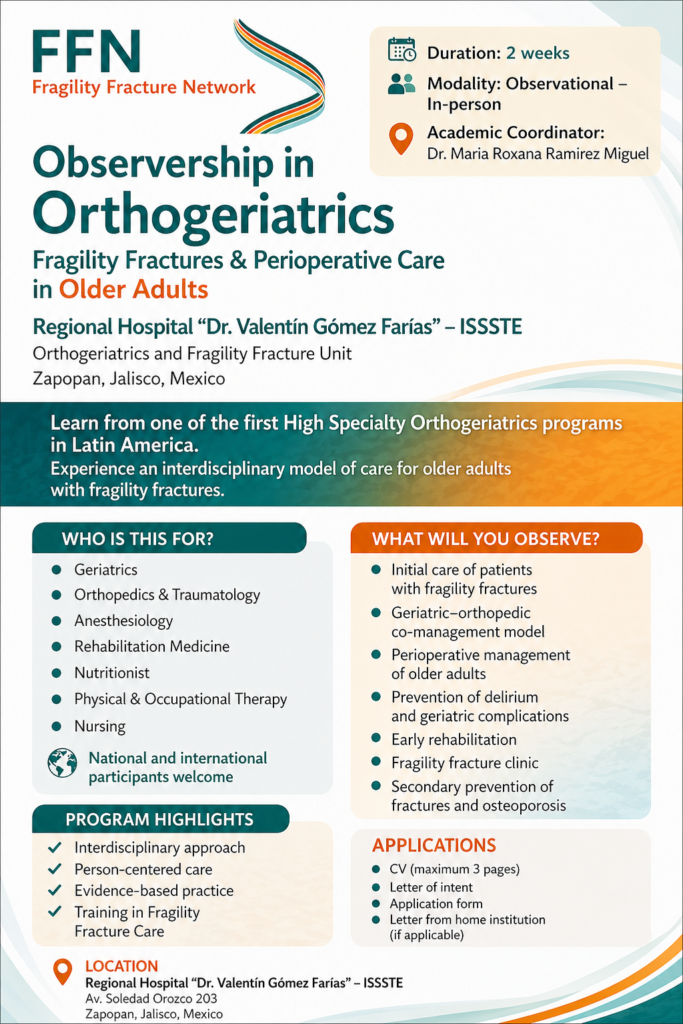
It is with enthusiasm that we present the Orthogeriatrics Observership Program at the “Dr. Valentín Gómez Farías” Regional Hospital – ISSSTE – Mexico, coordinated by Dr. María Roxana Ramirez.
The program aims to share the orthogeriatric care model implemented at the Orthogeriatric Unit and Fracture Clinic, which is the first highly specialized program in orthogeriatrics in Latin America. This program was designed as an exclusively observational rotation, without direct participation in clinical care, in line with the FFN principles for comprehensive care of older adults with fragility fractures.
The observership is designed for healthcare professionals interested in developing skills in the orthogeriatric model, including:
Applications from both national and international participants are welcome, in accordance with unit availability and institutional guidelines.
The standard duration of the observership is two weeks, with an approximate workload of up to 40 hours per week. Activities are typically scheduled from Monday to Friday, primarily in the mornings, and may include additional academic sessions at varying times depending on the hospital’s internal schedule. The program is in-person and strictly observational. Participants are integrated into the clinical and academic activities of the Orthogeriatrics Unit, as well as the services involved in the management of fragility fractures.
The call for applications will remain open, and you can apply by submitting the required documents via the Google Drive form.
We appreciate your interest in helping to strengthen this initiative, which aims to improve the treatment of osteoporotic fractures in Latin America.
Over the course of the previous strategic plan, FFN focused on several key initiatives that helped advance care for fragility fracture patients worldwide, including:
Leadership in Orthogeriatrics
Best Practices in Other Populations
Developing Leaders
Harmonizing Global Efforts
As we look ahead, we aim to further advance our mission and better address the evolving needs of fragility fracture patients worldwide. Your insights are essential in shaping this future direction. We invite you to share your perspectives through the following survey, helping us identify priorities and opportunities for the next five years.
Complete the survey here.
With the rapid aging of the global population, osteoporotic fractures represent an increasing
burden on public health. Among those, osteoporotic vertebral fractures (OVFs) are highly
prevalent and play a substantial role in causing pain, functional impairment, and diminished
quality of life among older adults.Percutaneous kyphoplasty (PKP) is the first-line surgical
intervention for eligible OVF patients. However, the perioperative period is often affected by
anxiety, sleep problems, and poor management of comorbidities like hypertension.
A recent study aimed to evaluate the efficacy of visual health education (VHE) intervention in
the perioperative management of older adults undergoing PKP for OVFs. A total of 96 older
adults with OVFs scheduled for PKP at a hospital were enrolled in this prospective cohort study
between June 2024 and January 2025. Patients were assigned to a control or an intervention
group, and both received education from the same multidisciplinary team.
The control group received conventional verbal instruction, with physical demonstrations when
required. In contrast, the intervention group participated in a supplemental VHE program
consisting of four animated videos addressing: (1) the pathophysiology and prevention of OVFs,
(2) the PKP procedure, (3) intraoperative positioning and precautions, and (4) postoperative
rehabilitation and anti-osteoporosis medication use.
The authors found that disease-specific visual health education is an effective approach to
optimize perioperative care and promote long-term self-management in older OVF patients
undergoing PKP, improving both subjective patient experiences and objective physiological
parameters. Nonetheless, further multicenter randomized trials with longer follow-up,
validated satisfaction metrics, and economic evaluations are needed to confirm these benefits
and support wider implementation.Fracture
Read the paper here: https://journals.sagepub.com/doi/full/10.1177/21514593251411417
As FFN continues its mission to improve care for fragility fracture patients worldwide, we are delighted to introduce this group of dedicated leaders who will help shape FFN’s priorities and initiatives in the years ahead. Their expertise and commitment will support ongoing efforts to strengthen collaboration, advance education, and improve fragility fracture care globally.
We warmly welcome them and look forward to their contributions to FFN.
President Elect
Jenny Thain, Orthogeriatrician, Canada
General Secretary Elect
Carmen Queirós, Specialist Rehabilitation Nurse, Portugal
Chair Elect Education Committee
Louise Brent, Nurse, Ireland
Chair Elect Scientific Committee
Jae-Young Lim, Rehabilitation Physician, Republic of Korea
Yunyang Jia, Nurse, China
Maria Nuotio, Geriatrician, Finland
A recent qualitative study in Saudi Arabia explored how patients and carers experienced weight-bearing and mobilization timing after hip fracture surgery. It also examined their views on unrestricted weight-bearing and early mobilization, as well as the perceived barriers to these practices. Semi-structured interviews were conducted with 25 participants (7 patients and 18 carers) recruited from multiple tertiary hospitals across different sectors in Saudi Arabia. An inductive thematic analysis was used to analyse the data, and three themes were identified and refined after discussions with the research team.
Navigating weight-bearing and mobilization instructions
Trust in clinician’s guidance and professional expertise
Supporting mobilization through emotional and practical care
The researchers believed that to support adherence to weight-bearing and mobilization instructions, clinicians should provide timely, consistent prescriptions aligned with evidence-based guidance. Communication must be inclusive to support understanding, confidence, and autonomy among patients and carers.
Read the article here.
FFN Position on Postoperative Weight Bearing After Hip Fracture Surgery
The FFN position paper emphasizes early, unrestricted weight bearing and mobilization as key components of hip fracture care. This position is grounded in growing global evidence favoring full weight bearing as tolerated (WBAT) immediately after surgery and advocates that postoperative protocols should prioritize appropriate surgical fixation to achieve WBAT “as tolerated” for hip fracture patients. Learn more here.
© 2026 Global Fragility Fracture Network | All Rights Reserved I Designed by Aaron Knight
